
Sankai Juku was formed in 1975 by Ushio Amagatsu, who belongs to the second generation of Butoh dancers; Tatsumi Hijikata and Kazuo Ohno being the founding fathers. Butoh is a form that transcends the reactions of the “post-Hiroshima” generation in Japan and laid the foundations for a radical approach to Japanese contemporary dance starting in the late 1950s.
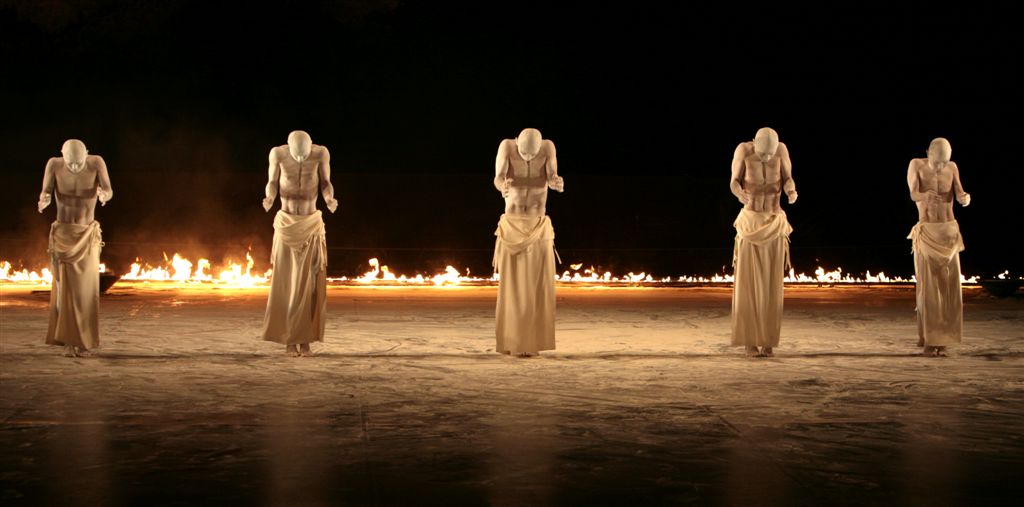
Before that, Amagatsu had trained in classical and modern dance in Tokyo and had also explored traditional Japanese dances.
In 1975, he began a series of long workshops over several months to form his own company. Of the 30 boys and girls at the start, only 3 men remained at the end. Sankai Juku would therefore be male! Its name literally means “mountain and sea workshop,” referring to these two determining elements of Japan’s topology.
Sankai Juku, a fully independent company, then began its performances in Japan in rented venues. Sankai Juku’s first major production was “Kinkan Shonen” in 1978. It revealed Amagatsu’s artistic direction, giving Butoh a clearer, more transparent, and more cosmogonic image.
The strength of each expression, each movement, each impulse, always leads back to the origins of the world to offer a passionate understanding of life and death.
In 1980, Sankai Juku was invited to Europe for the first time. From this first physical encounter with foreign cultures, Amagatsu developed his theory of a balance between “ethnic” cultures, including his own Japanese culture, and a search for universality.
For Amagatsu, Butoh is not simply a formal technique or an academic style; it tends to articulate the language of the body to find, in the depths of being, a common meaning—a humanist universality—even if it sometimes requires resorting to cruelty or brutality.
His personal research is based on a “Dialogue with Gravity,” the title of his book published in 2001. The dancer uses gravity not as an opponent but as an ally in his movement. While the Western dancer tries to escape gravity through energy in jumps, pirouettes, and beats, Amagatsu’s dancer dialogues with it in a movement where everything is concentration and economy of muscular expenditure.
Thanks to its annual international tours for nearly 30 years, as well as workshops and master classes led by Sankai Juku in Paris, Japan, and elsewhere, the unique style of Sankai Juku and its particular aesthetic have now spread worldwide. They now influence a growing number of artists in fields as diverse as contemporary dance, theater, painting, fashion, and photography.
Today, Sankai Juku is undoubtedly one of the Japanese companies that tours the most abroad (regularly visiting more than 43 countries and 700 cities), with a very special focus on France and the Théâtre de la Ville in Paris, where it has premiered its new productions every two years since 1982.
Amagatsu considers France his second home because it was in France that Sankai Juku’s international adventure began. France has greatly nurtured him with varied artistic influences through contact with so many artists, by enjoying its monuments, museums, and exhibitions, by admiring the beauty of its landscapes, and of course, through his friends.
Sankai Juku, whose members all live in Japan, prepares its new creations and international tours there. The company’s offices are located in Tokyo in the Minato-ku district.
Outside of Sankai Juku, Amagatsu has created two pieces for Western dancers in the USA and Tokyo. He also choreographed for Indian dancer Shantala Shivalingappa. He directed Bela Bartok’s Bluebeard’s Castle in Japan and the world premieres of Peter Eotvos’ operas Three Sisters and Lady Sarashina at the Opéra de Lyon.
From 1993 to 2017, Pierre Barnier (Per Diem & Co) organized the company’s tours in Europe, the Middle East, and South America, and coordinated Amagatsu’s French activities, particularly with the Théâtre de la Ville, the Opéra de Lyon, and Editions Actes Sud, Amagatsu’s publisher in France.
In 2017, a chapter closed. Perdiem&Co stepped down, and [H]ikari Production now represents the Sankai Juku company in France and Europe.
Distinctions:
Chevalier des Arts et Lettres. France.
President of the jury for the Rencontres Internationales de Bagnolet. France.
Ministry of Foreign Affairs Prize. Japan.
National Critics’ Association Prize for “Three Sisters”. France.
Japan Dance Critics’ Association Award.
Laurence Olivier Award: Best New Dance Production for “Hibiki”.
Great Britain. President of the Jury for the Toyota Choreography Award. Japan.
Art Encouragement Prize from the Ministry of Education, Culture, Sports, Science and Technology. Japan.
Grand Prix of the 6th Asahi Performing Arts Awards. Japan.
National Critics’ Association Prize in France for “Lady Sarashina”. Japan
Foundation Award. Commandeur des Arts et Lettres. France.
Books:
1982 “SANKAI JUKU I” photography book, Shinyasosyo
1983 “SANKAI JUKU II” photography book, Shinyasosyo
1986 “LUNA – Sayoko / Sankai Juku” Photography by Noriaki YOKOSUKA, PARCO publishing
1994 “UNETSU / SANKAI JUKU” Photography by Gan FUKUDA, Direction Ushio AMAGATSU, Libro port
1994 “SANKAI JUKU – AMAGATSU”, DELAHAYE, Photography by DELAHAYE, ACTES SUD
1995 Yoshihiko UEDA photo book “AMAGATSU” Photography by Yoshihiko UEDA, Korin-Sya
2000 “DIALOGUES AVEC LA GRAVITE” by Ushio AMAGATSU, essay, ACTES SUD
2003 “SANKAI JUKU – AMAGATSU”, DELAHAYE, new edition, ACTES SUD
Repertoire:
The following pieces are currently in the SANKAI JUKU touring repertoire. KINKAN SHONEN The Kumquat Seed (1978, re-created in 2005) UNETSU The Flashing of Eggs to Tell (1986) HIBIKI (1998, Laurence Olivier Award, Best New Dance Production, London, 2001) KAGEMI (2000) TOKI (2005) TOBARI (2008) UTSUSHI (2008) UMUSUNA (2012) MEGURI (2015)